Why Annealing Treatment Becomes a Key Step in Processing High-Purity Tantalum Rods
Why do you need annealed tantalum rods?
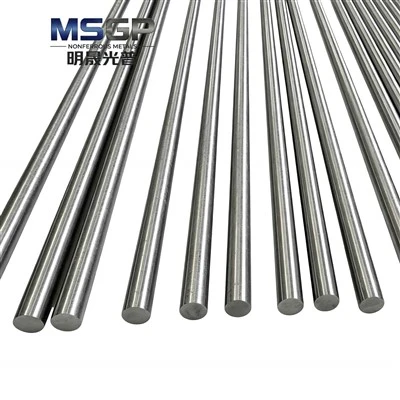
Tantalum is a refractory metal, and residual stress is easy to accumulate inside after cold working. High hardness and decreased ductility are common states of unannealed tantalum rods. Especially under the requirements of small diameter specifications or precise tolerances, the risk of micro-cracks or even fractures will be obvious during drawing, turning, and stamping.
The central role of annealing is to rearrange the grains at a controlled temperature, release these stresses, and at the same time make the structure more uniform. This is not simply "softening", but bringing the material to a state more suitable for subsequent forming.
How does annealing specifically improve processability?
A regular annealing process will strictly control the temperature, holding time, and cooling. High temperature is easy to cause grain growth and strength decline; If the temperature is insufficient, the stress relief will not be complete. Only when the parameters match the end use can the ductility be improved while retaining the necessary mechanical properties.
For processing plants, the consistency of annealing in the same batch is often more important than the index of a single bar. The annealed tantalum rods with uniform microstructure have better dimensional stability in the manufacture of complex parts, and are not easily deformed due to residual stress after forming.
What benefits can be brought in practical application?
When annealed tantalum rods are used to make capacitor-related components in the electronics industry, the forming efficiency is higher, and the size control is more stable. In the manufacturing of chemical equipment, the welding and bending processes will be smoother, and the scrap rate will be lower. The medical field has strict requirements on surface and internal defects, and uniform organization also contributes to subsequent precision polishing and machining.
It should be noted that annealing does not change the corrosion resistance of tantalum itself; it only improves the processability to a more practical level.
What is recommended to pay attention to when purchasing annealed tantalum rods?
In addition to looking at the purity report, it is recommended to know more about the specific control of the annealing process and whether the corresponding test records are provided. These details often reflect the actual reliability of the material more than the price alone.
If your project involves precision forming or requires high processing consistency, choosing tantalum rods that have undergone standardized annealing treatment can often lead to fewer risks later. Welcome to communicate the specific working conditions at any time, and we can provide targeted material suggestions according to your actual needs.
NAME
Ava