




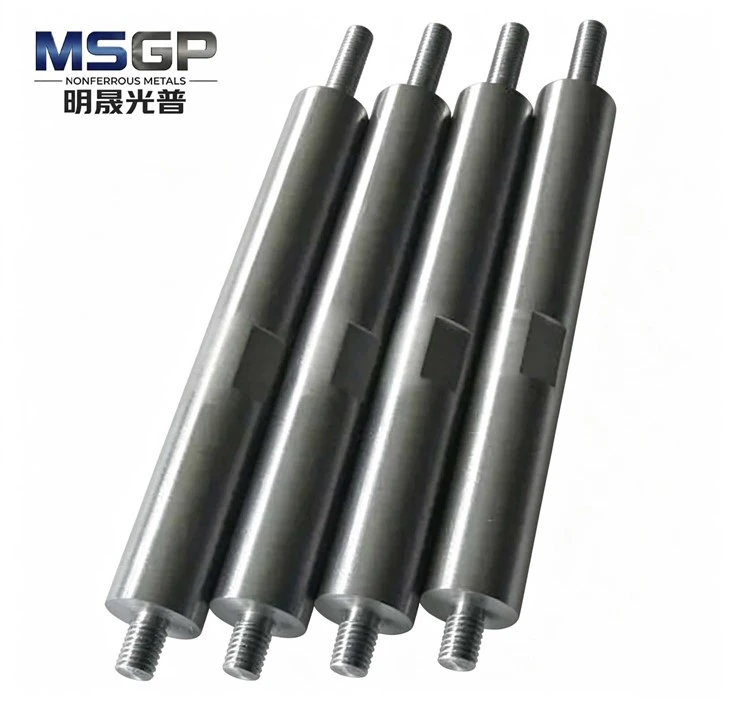
Products Description
These electrodes are used to conduct electricity to create heating directly in the glass melt. The glass melting furnace creates a current loop through the glass melt creating heat via the electrical resistance of the glass. Our molybdenum electrodes are forged from high purity ingot, machined to the furnace drawing and threaded to match the existing holder on your tank.
Why Molybdenum?
High melting point
Molybdenum has a high melting point of 2623°C, excellent high-temperature strength and high electrical conductivity, and a low coefficient of thermal expansion. Molybdenum is not easily soluble in most glass components, and high-purity molybdenum does not discolor the glass. Therefore, it is the standard material for transparent borosilicate glass, fiberglass, and fused glass.
Tin oxide
Other materials each have their drawbacks. Tin oxide (SnO2) is suitable for lead-containing and strongly oxidizing melts, but it is brittle and has a high resistivity, thus requiring larger cross-sections.
Graphite
Graphite is inexpensive and has good electrical conductivity, but it is easily oxidized, which can cause discoloration or reduce the purity of the glass. Platinum is resistant to almost all corrosion, but it is expensive per gram, so it is used only in small quantities for optical and special melts.
High temperature resistance
Molybdenum offers a practical solution. It can withstand high temperatures, has predictable wear resistance, and is relatively inexpensive, allowing multiple electrodes to be produced per furnace. Forged molybdenum has a coarse-grained structure that effectively resists creep. This means that long electrodes can remain straight even at high temperatures, requiring only a single support point.

Conductivity and Heating Principles
The glass melt conducts electricity via ion movement so acts as a heating resistor. The electrodes are inserted into the furnace either from the side, bottom or throat. The current flow between the two electrodes will help dictate what area the heating occurs and how the glass melts.
Two Application Conditions
Full melting using these electrodes will mean the electrode provides all of the energy requirement for melting. In this case the furnace is operated as a cold topped tank, ideal for borosilicate, aluminosilicate, frit and fiber glasses. When boosting with electrodes they provide extra energy input on top of fossil firing, helping increase pull rate, fining and adjust hot spot location.
Electrode Operating Characteristics
In both situations these are consumables and are designed to last a certain number of campaigns. We will deliver an electrode that will conduct electricity with a consistent contact area for the duration of the campaign. It will then be changed or advanced with minimal impact to the furnace wall. The electrode must fit the electrical requirements and mechanical requirements. It must also survive the environment above the melt and within the glass.
product parameters
| Property | Value |
| Material | Pure molybdenum, ≥99.95% (99.97% on request) |
| Density | ≥10.2 g/cm³ |
| Melting point | 2623 °C |
| Surface | Fine-forged or machined, oxide-free |
| End forms | Metric or UNF threads, taper threads, stepped, drilled |

FAQs
1. What purity do I need for glass melting electrodes?
For clear glass applications most will be 99.95% or higher. This will keep the iron, nickel and carbon low to not affect colour or cause bubbles. For tight optical/electronic glass specs they will usually be 99.97%.
2. Can you machine to my holders thread?
Yes we can. Please send us the holder drawing or thread designation and we can match this to your holder. We can also match taper threads. Threads will be checked to ensure they are the correct gauge.
3. How long will the electrode last?
This depends on the environment above the glass line, glass chemistry and current density. Generally the sections that are fully submerged will last a lot longer than those exposed.
4. Do you offer plates?
Yes we do. We can also offer step and drilled. Plates are commonly used for bottom installations where the current per electrode is high.
5. Are you able to quote from a drawing?
Please send us the furnace drawing, type of glass and current per electrode using our contact form. We will then be able to advise on the recommended diameter, matching thread and delivery time. Related Products: Molybdenum tubes for glass furnaces, Molybdenum plates.
Information Needed
To provide a useful quotation we will need: Glass composition and melt temperature, Type of furnace, Melting or boosting, Location and angle of installation, Current and Voltage per electrode, Immersion Length and Wall drawing, Thread or holder interface. Quantity and delivery pattern. Electrodes are typically ordered in a set for a campaign with some spare.
If you have a drawing from the furnace manufacturer please send this. If not measure up the electrode you have and take a picture of the end of the failed electrode. This will help us quicker than trying to write a spec. The pictures will usually show why the electrode didn't last as long as expected.
Consider how much you want to order. It is usually best to order a set for the campaign with 1-2 extra. This way if the electrode fails you don't have to stop production. You can replace the electrode at your next planned maintenance period as it will be thinning.
NAME
Ava
18291778622

Hot Tags: molybdenum electrodes, China molybdenum electrodes manufacturers, suppliers, factory, Mo1 Molybdenum Ronud Rod, molybdenum rod


