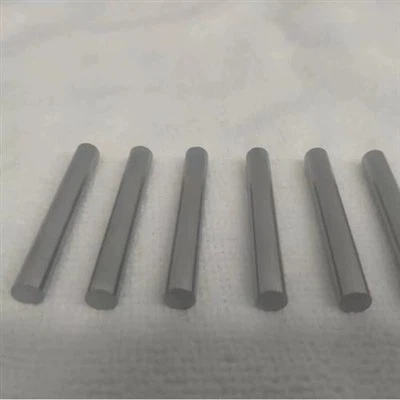


Products Description
Molybdenum rods can be used as heating elements in vacuum/hydrogen furnaces, rail or support bars in the hot zone to support a load at 1500 °C, electrode bushes and threaded rods to connect radiation shielding. The rods are made from high purity molybdenum by forging or swaging. They are supplied as straight, oxide free lengths of specified length, with threads/bends machined according to drawing. This page includes information on applications, grades and sizes, and how to specify a robust set of rods.
Types
Forged rods
Forged, Swaged and Drawn rods behave differently. Forged rods offer a coarse microstructure with good resistance to creep. They are suitable for large diameters, supporting heavy loads, or long heating elements which must remain straight.
Swaged rods
Swaged rods, produced by rotary forging, are suitable for smaller/medium diameters and have a dense uniform microstructure and good surface finish.
Drawn rods
Drawn rods are the cheapest option, have good dimensional control and are ideal for structural components that do not operate at the upper limit of temperature.

Heating element
Molybdenum rods may be used as heating elements, structural components or electrical bushes. As heating elements, the rods are sized depending on resistance, surface area and required temperature. Temperatures in the hot zones typically range from 1000-1700 °C. Usually beyond 1700 °C, tungsten is a more common material as molybdenum ceases to be a competitive option due to reduced creep strength and increased vapour pressure.
Structural components
As structural components, molybdenum rods may be used as rails (to support a sintering boat), support pins (to support stacks of radiation shielding) or brackets to hold crucibles. In this case, the main issues to consider are creep and distortion, and the rod sizes chosen allow rigidity at operating temperature.
Electrical conduit
As electrical bushes, molybdenum rods pass through the vessel wall and connect the hot zone to a water cooled copper termination. Therefore the joint and its cooling matter more than the rod itself. Many applications combine two of the above uses. When making a quotation request, it is helpful to know which application is dominant.
product parameters
| Property | Value |
| Grade | Pure molybdenum (Mo1 / ASTM B387 equivalent) |
| Recrystallisation range | 800–1200 °C, depending on deformation history |
| Diameter range | 3–100 mm, other sizes to drawing |
| Straightness | <1.0–2.5 mm per metre, by diamete |
| Delivery forms | Cut lengths, threaded ends, bends, drilled, tapped |

FAQs
1.Can molybdenum rods be used as heating elements in air?
No. Molybdenum will begin to oxidise at ~400°C. If heating elements are required for air, molybdenum disilicide elements are suitable. Molybdenum rods are suitable in vacuum, dry hydrogen or inert environments.
2.What is the maximum temperature?
This depends on loading and atmosphere, but molybdenum is typically used from 1000-1700°C. Above ~1700°C tungsten is usually a better choice.
3.Why did my rod break during maintenance?
Recrystallized molybdenum is brittle at room temperature. The rod may have functioned correctly for many months, but broke under light impact during unloading.
4.Can I get threaded rods to fit an existing element?
Yes. Please provide a thread specification, or matching nut and we can provide matching rods. We will check the thread gauge prior to dispatch.
Testing and Certification
Every batch of rods is tested to confirm chemical composition, density and dimensions. A certificate is provided with testing results. Chemical composition gives a breakdown of every impurity present in the rods. Iron, Nickel, Carbon, Oxygen and Nitrogen levels are given specifically as they determine if early embrittlement occurs, or if the rod is robust. Density is measured in a sample from the same batch. Low density samples have reduced creep resistance, and will oxidise from internal surfaces.
Dimensions include diameter (measured in multiple points), straightness (checked on surface plate), and thread pitch (if applicable). Lengths are measured to check against drawing. Large or critical parts may be supplied with individual certificates. Hardness is measured on a sample to ensure that the parts have not been over-annealed during processing. If the rods arrive soft they have partially lost structure that they were purchased for. Rods are packaged in stiff tubes or supportive crates, and kept dry during transit. If a rod has bent in a poor delivery, it is not worthwhile to make a warranty claim on a critical component.
NAME
Ava
18291778622

Hot Tags: molybdenum rods for high-temperature furnaces, China molybdenum rods for high-temperature furnaces manufacturers, suppliers, factory, Mo1 Molybdenum Ronud Rod, molybdenum rod