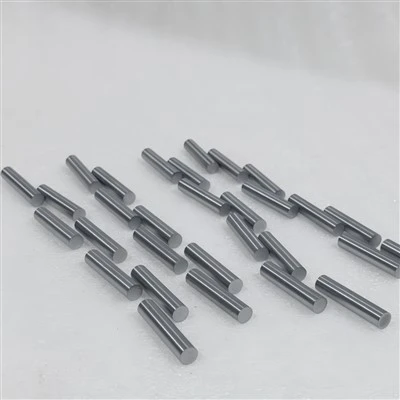
Vacuum Melting Molybdenum Target Core Precautions
|
Casting coarse columnar crystals (the most severe defect)
They naturally form during melting and solidification, with weak grain boundaries and prone to cracking along the grain when heated. |
The total deformation during forging and rolling is ≥ 60-70%, which effectively breaks the columnar crystals; Recrystallization annealing is precisely controlled by temperature and time, resulting in uniform fine crystals. |
| Internal shrinkage cavities and microcracks Internal cracks may occur due to melting and solidification shrinkage or improper heat processing. |
Control the melting rate and cooling speed to avoid concentrated shrinkage; 100% ultrasonic testing (UT) is used for quality control of the finished product. |
| Gas and low-boiling-point impurities residue Residual O/C/N/H will release gas and cause embrittlement, affecting the purity of the target material. |
Maintain a high vacuum (10⁻³~10⁻⁴ Pa); 2-3 remeltings are carried out to fully degasify, And gas content is tested and verified after casting. |
|
Copper crucible contamination and atmosphere oxidation
|
Regular leak detection and monitoring of cooling for the water-cooled copper crucible; Continuous monitoring of vacuum degree and atmosphere during melting to prevent leakage. |
| Recrystallization grain coarsening and mixed crystals Excessive annealing or uneven temperature causes coarse grains or mixed crystal structures. |
Precisely control the annealing temperature and time (±10℃ level); Conduct batch metallographic tests to measure grain size and uniformity. |
| End-of-run thermal shock cracking The grain boundaries are prone to cracking under high-frequency thermal shock, resulting in a sudden decrease in the lifespan of the target material. |
It is limited to static and low thermal shock scenarios; control the sputtering power, Avoid local overheating; X-ray targets / high-power sputtering select powder metallurgy |
Sintered ingot and hot processing stage
1. Columnar crystals must be broken: The coarse columnar crystals in the cast state are the biggest inherent defect of molten casting molybdenum, and the total deformation during forging/rolling must be ≥ 60-70% to be sufficient;
2. Forging temperature window: Molybdenum has high brittleness at low temperatures, and it needs to be processed in the plastic zone at approximately 1200-1400℃; too high a temperature leads to grain growth, and too low a temperature results in immediate cracking;
3. Internal cracks: Internal cracks are prone to occur during the processing, and 100% UT ultrasonic testing must be conducted.
Contact person :
Our address
Baoji city, shaanxi province, China
Phone Number
0086-18291730106