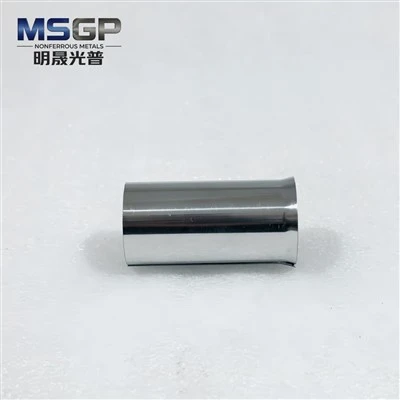
Nickel crucibles are common high-temperature vessels used in laboratory alkaline fusion, metal addition, and alloy melting. Their quality depends largely on the forming process. At present, there are two main technical routes for forming nickel crucible bodies: spinning and stamping. Spinning relies on rotation and roller pressure to gradually shape the material against a mandrel, making it suitable for large-diameter, small-batch products. Stamping relies on dies and presses, allowing a circular blank to deform progressively through multiple dies. It is better suited to batch production of small and medium-diameter crucibles, offering excellent batch dimensional consistency and stable wall thickness control.
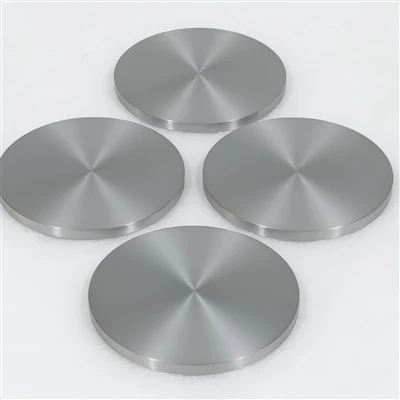
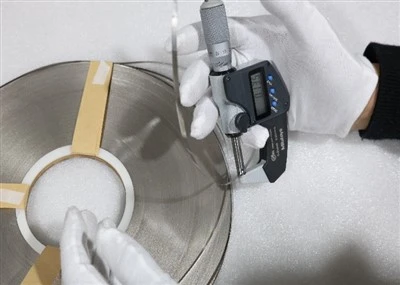
The starting point of the stamping process is high-purity electrolytic nickel sheet, typically with a nickel content of no less than 99.5%. After shearing, the nickel sheet is fed into a blanking die, where a circular blank of specified diameter is punched out. The blank diameter is not determined arbitrarily; it is calculated backward from the crucible's final capacity, outer diameter, height, and the drawing coefficients of each stage. If the blank is too small, the subsequent drawing height will be insufficient; if too large, the material is prone to wrinkling or excessive thinning during drawing. A central locating hole or positioning mark must also be punched during blanking to provide a concentric reference for every subsequent stamping stage. This is the prerequisite for ensuring the roundness and verticality of the crucible.
The first stamping completes blanking and initial positioning. The circular blank establishes its geometric reference in this operation, and all subsequent forming is developed from this reference. This stage may appear simple, but it directly determines the coaxiality of the crucible. If the positioning deviation is too large, subsequent drawing stages will amplify the error progressively, ultimately resulting in an out-of-round rim and poor lid fit.
The second stamping places the blank into the first drawing die and stamps it to an intermediate size slightly larger than the finished outer diameter, allowing the blank to take on a preliminary cup shape. The key to this stage is controlling material flow so that wall thickness begins to redistribute along the height. The pre-forming size is left with a margin to reserve deformation space for subsequent sizing and deep drawing, avoiding localized stress concentration caused by drawing to final size in one pass.
4: Third Stamping: Outer Diameter Finishing
The third stamping continues to reduce the diameter on the basis of pre-forming, bringing the outer diameter close to the finished size while further increasing cup height. After this stage, the outer diameter of the crucible is essentially established, wall thickness uniformity is markedly improved, and the rim begins to take shape. The core of this stage is "reducing" - bringing the diameter to accurate size without excessively thinning the wall, laying a solid foundation for the next deep drawing stage.
5: Fourth Stamping: Deep Drawing
The fourth stamping involves the largest deformation among the five stages, focusing on drawing the cup body to the designed depth. During stamping, the material flows axially, and the thickness of the bottom and wall is precisely controlled by the die clearance. If the clearance is too large, wall thickness will exceed tolerance; if too small, the material will be scratched or even cracked. After this stage, the main shape and depth of the crucible essentially meet the finished product requirements, with a flat bottom, uniform wall thickness, and a weld-free structure - the core advantage of the stamping process over welded crucible structures.
6: Fifth Stamping: Sizing and Lid Fitting
The final stamping stage handles sizing and lid fitting. Sizing corrects the roundness, verticality, and bottom flatness of the crucible; rim finishing determines whether the lid can fit tightly. The lid of a lidded nickel crucible has a flat-top structure with concentric circular texturing on its underside. Only when this texturing and the rim dimensions are controlled in coordination within the same stage can a tight seal be achieved, effectively suppressing sample splashing and volatilization loss. After sizing is completed, each crucible undergoes dimensional verification and surface quality inspection to ensure batch consistency.
7: The Process Logic of Five-Stage Stamping
The core logic of five-stage stamping is "distributing deformation progressively." If a single drawing deformation is too large, the material will crack due to work hardening and excessive thinning; if too small, the number of stages increases and die costs rise. Reasonably distributing the total deformation across five stamping stages ensures that no defects occur in the material while achieving uniform wall thickness and stable dimensions. At the same time, multi-stage stamping gradually densifies the material structure, giving the product better fatigue resistance in repeated thermal cycling environments and a longer service life under high-temperature conditions such as metal addition and alloy melting.
In summary, a qualified lidded nickel crucible undergoes five stamping stages from a circular blank to the final product: blanking and positioning, outer diameter pre-forming, outer diameter finishing, deep drawing, and sizing with lid fitting. Each stage performs its own function and approaches the final dimensions step by step, ultimately achieving uniform wall thickness, a weld-free structure, and batch consistency, providing reliable support for laboratories and industrial production.
Name
Lisa
Phone Number/weChat/whatsApp
(86)-18291772322
Ta-Nb@titanmsgp.com