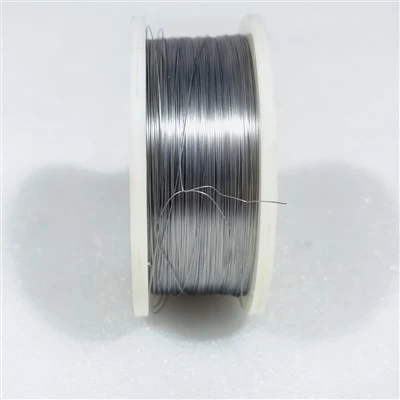
Niobium C103 Sheet refers to plate or sheet products made from the C-103 niobium-based alloy. C-103 is a classic high-temperature refractory metal alloy with a nominal composition of approximately 89% niobium (Nb), 10% hafnium (Hf), and 1% titanium (Ti), sometimes containing minor zirconium (Zr). It is designated UNS R04295 and is also known as Nb-10Hf-1Ti or WC-103. This body-centered cubic (BCC) refractory alloy has a density of about 8.85 g/cm³-the lowest among refractory metals-and a melting point of roughly 2350 ± 50°C.
Developed in the early 1960s by U.S. organizations (including Wah Chang and Boeing) for aerospace propulsion systems, C-103 was designed to meet the dual requirements of high-temperature, high-stress structural performance while retaining good fabricability. It first saw service in the Apollo program on the nozzle extensions of the lunar module and service module engines. Since then, it has remained one of the most widely used niobium alloys in space propulsion, appearing in rocket nozzles, thrust chambers, satellite attitude-control thrusters, and hypersonic vehicle components.
The primary strength of C-103 lies in its balanced combination of elevated-temperature strength and excellent fabricability. At room temperature it exhibits outstanding ductility (elongation typically ≥20%) and a low ductile-to-brittle transition temperature (as low as –150°C or lower), enabling it to withstand high-frequency vibrations under cryogenic conditions. At elevated temperatures (up to approximately 1480°C / 2700°F), it retains useful strength and creep resistance, making it particularly suitable for radiation-cooled nozzle environments.
Typical mechanical properties (annealed condition, per ASTM B654 and related standards):
Room-temperature tensile strength ≈ 370–385 MPa (depending on thickness), yield strength ≈ 260–275 MPa, elongation ≥20%.
At ≈1093°C (2000°F), tensile strength ≈145 MPa, yield strength ≈110 MPa, while still maintaining good ductility.
Physically, it offers moderate thermal conductivity (superior to many nickel-based superalloys), a relatively low coefficient of thermal expansion, and an elastic modulus in the range of about 90–110 GPa. Among refractory metals it is comparatively easy to cold-work, form, and weld (especially by TIG), which has been a major factor in its long-term selection.
A critical limitation is that uncoated niobium and its alloys oxidize rapidly in air at high temperatures. In service, C-103 components almost always receive protective silicide coatings (such as R-512E), which enable reliable operation at the higher end of its temperature capability.
2. Product Forms and Specifications
Niobium C103 Sheet typically denotes thinner gauges (commonly 0.024–0.1875 in / ≈0.6–4.8 mm thick) with widths up to about 24 in (61 cm); thicker plate is also available. Primary specifications include:
ASTM B654/B654M (plate, sheet, and strip)
AMS 7852 (sheet/plate)
Related standards for billet, bar, and wire such as ASTM B652, B655, and AMS 7857.
The alloy is produced by vacuum melting (electron-beam or vacuum-arc) to obtain homogeneous ingots, followed by forging, rolling, and annealing. Material is supplied in the annealed or recrystallized condition with high surface quality suitable for subsequent precision forming and welding.
3. Principal Applications
Space propulsion systems-the dominant use. Radiation-cooled nozzle extensions (including those on Apollo engines and the SpaceX Falcon Merlin Vacuum nozzles), combustion chambers, thrust chambers, and attitude/orbit-control thrusters. Low density aids structural weight reduction, while high ductility facilitates complex forming and welding.
Missiles and launch vehicles-thrust-vectoring nozzles and high-temperature structural parts.
Aircraft engines-afterburner-related components (e.g., flaps).
Hypersonic and extreme-environment applications-leading edges, thermal-protection elements, and parts subjected to thermal cycling and high-frequency vibration.
Emerging uses-C-103 powder for additive manufacturing has enabled the production of complex thruster geometries, expanding design possibilities.
4. Industry Position and Outlook
Although C-103 is not the highest-strength niobium alloy available (later alloys such as Nb521 offer superior elevated-temperature strength), its excellent overall fabricability, reliable weldability, and extensive flight heritage have made it a workhorse material. It strikes a practical balance among cost, performance, and manufacturability, suiting both high-reliability and higher-volume requirements. Key supply-chain factors include the availability of niobium and hafnium, tight control of melting purity, and coating technology.
Production demands strict control of interstitial impurities (especially oxygen, nitrogen, and carbon) and processing under high vacuum, resulting in relatively high material cost. In service, protective atmospheres or intact coatings are essential to prevent high-temperature oxidation and property degradation.
In summary, Niobium C103 Sheet is an indispensable specialty flat product for high-temperature aerospace structures. By combining niobium's low density and ductility with the strengthening effects of hafnium and titanium, it delivers reliable performance under extreme temperature and stress. From the Apollo era through today's commercial space programs, it has remained a foundational material for lightweight, high-temperature propulsion systems. Continued advances in additive manufacturing and protective coatings are expected to further broaden its application range.
lisa
Sales Manager
Phone Number/weChat/whatsApp
(82)-18291772322
Ta-Nb@titanmsgp.com