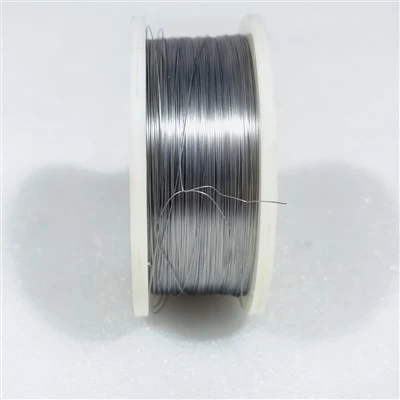
How to reduce and prevent the situation where tungsten wires fall off during vacuum thermal evaporation coating process?
Vacuum thermal evaporation coating: Preventing wire detachment / falling off, dropping particles - The tungsten wire body comes loose and falls off from the electrode clamp (mechanical detachment)
Vacuum thermal evaporation coating: Preventing wire detachment / falling off, dropping particles - The tungsten wire body comes loose and falls off from the electrode clamp (mechanical detachment)

01
Material selection: Reduce the risk of fracture and material loss at the source
Select annealed stress-relieved high-purity tungsten twisted wires (W ≥ 99.95%)
Cold-processed unannealed tungsten wires have large internal residual stress. After high-temperature electrification, they will rebound, deform, and the coils will disperse, easily slipping off the fixture; therefore, only finished products that have undergone past stress annealing should be selected for the tungsten twisted wires.
The coil pitch should be stable, and the wires should not loosen at high temperatures.
◦ Vacuum evaporation: Multi-strand twisted wires;
for high-load applications, choose thick wire diameter and basket coils (basket coil). The loading is stable, and the aluminum liquid is less likely to drip.
◦ Avoid tungsten wires with high impurity content: Impurities cause local hot spots, resulting in local thinning and brittle breakage.
02
Matching twisted wire structure with evaporation materials
The pitch should not be too large (aluminum melting is prone to dripping); if the pitch is too small, the material coating is too thick, and the thermal expansion stress is large, causing large chunks of the material to peel off.
Loading quantity control: Do not load fully; the recommended loading amount should not exceed 60-70% of the twisted wire's capacity; excessive loading will cause the molten metal to pull the twisted wire, and after cooling, the material will form a lump and contract, causing the tungsten wire to tear and fall off in large pieces
03
Electrode fixture material and clamping method
The fixture should prefer tantalum or molybdenum; copper fixtures will have a sudden increase in contact resistance after high-temperature oxidation, leading to local overheating. On the one hand, it will ablate the end of the tungsten wire, and on the other hand, the oxide layer will slip, causing the tungsten wire to detach and fall off.
◦ Clamping force: Moderately clamp, do not crush the tungsten end forcefully. Tungsten is very brittle at room temperature, and pressing out micro-cracks will cause it to break directly; after the thermal cycle, it will directly break;
◦ Clamping length: Ensure that the ends of the twisted wire extend into the fixture ≥ 3–5mm, and the clamping area is sufficient; do not only clamp a little of the wire end; after high-temperature creep, it will be pulled out and fall off directly.
◦ Inspection: Each time loading the wire, gently pull to confirm that it does not slide; the contact surface of the fixture should be polished clean to remove old metal deposits and oxide films.
04
Reserve thermal expansion allowance during installation
Tungsten expands at high temperatures. Do not forcibly tighten and straighten it. Reserve a small amount of relaxation during cold installation; if the cold installation is too tight, the expansion at high temperatures will generate huge tensile stress, causing it to break directly or pull out of the fixture
5.Installation position
Horizontal installation of the twisted wire is preferred; the inclination angle should not be too large to prevent the molten metal from concentrating on one side, causing local weight increase and pulling the coil. A molybdenum shield plate or shielding board can be added below the twisted wire to prevent particles from dripping and protect the substrate.
Contact person: Tracy
Our address
Baoji city, shaanxi province ,China
Phone Number
+86-18291730106