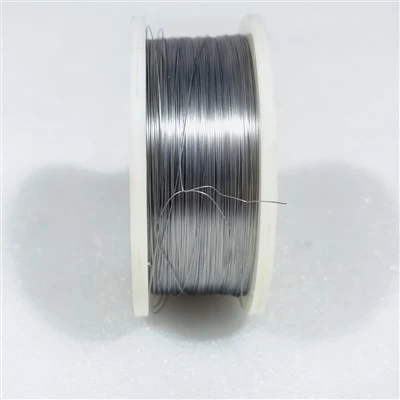
Application of Molybdenum Capillary in ALD Process
Atomic layer deposition (ALD) is one of the most precise thin film fabrication technologies in the fields of semiconductors, display panels, and advanced packaging. By alternating with different precursor gases, it can achieve uniform, dense and pinhole-free thin film deposition on the atomic scale. The whole process requires extremely high precision, purity, and high temperature stability of the gas delivery system, and a molybdenum capillary is an indispensable key component in this system.
1. Main application location
Precursor gas injection tube: ALD equipment usually requires precise delivery of metal-organic precursors (e.g., TMA, TDMAH, etc.) and reaction gases (e.g., O3, H2O, NH3) to the reaction chamber. Due to their small inner diameter (usually in the range of 0.2- 2 mm) and uniform wall thickness, molybdenum capillaries are widely used as injection pipelines near the spray head, which can achieve rapid gas response and precise distribution.
Pulse Valve Downstream Delivery Pipe: After quickly switching the valve, the molybdenum capillary can effectively retain gas and pulse tail, ensuring a high degree of dose consistency in each cycle.
High-temperature isolation and protection tube: Some ALD equipment needs to be arranged near the high-temperature base. The molybdenum capillary tube can withstand the operating temperature of 500-1200 °C, and will not release metal ions to pollute the film.
2. Core technology advantages
High temperature stability: The ALD process is often carried out at 200-500 °C or even higher temperatures. Ordinary stainless steel or quartz tubes are prone to particles or deformation during use, while molybdenum capillary tubes can work stably.
High purity and low precipitation: High purity molybdenum (above 99.95%) has extremely low impurity content and will not introduce carbon, oxygen, and other elements that affect the electrical properties of the film into the reaction gas.
Excellent thermal conductivity and thermal shock resistance: Can quickly follow cavity temperature changes, condensation, or decomposition of precursors.
High dimensional accuracy: Internal diameter and wall thickness tolerances are strictly controlled to ensure the consistency of gas flow between different cavities, which is particularly important for mass-produced large-size wafers (such as 300mm).
3. Actual workmanship value
In the deposition of high-k gate dielectrics (HfO2, ZrO2), metal gates, barrier layers (TiN, TaN), and emerging 2D materials, the use of molybdenum capillaries can significantly improve:
-film thickness uniformity (Within-Wafer Uniformity)
-inter-lot repeatability
-Equipment operating cycle (maintenance due to pipeline contamination)
At present, some high-end models of international mainstream ALD equipment suppliers (such as ASM, Veeco, LAM, etc.), as well as advanced process production lines of many domestic fabs, give priority to molybdenum capillaries in key gas paths.
Summary
Although the molybdenum capillary is only a tiny part in the ALD system, it is directly related to the "last mile" accuracy and reliability of gas delivery. Today, the ALD process is increasingly pursuing high uniformity, low defects, and high output, and it has become an important support to ensure the stability of the process.
If you are in the process of ALD equipment selection, transformation, or process optimization, welcome to provide specific precursor type, operating temperature, and pipe diameter requirements; I can help you analyze the key points of selection in a more targeted manner.
NAME
Ava