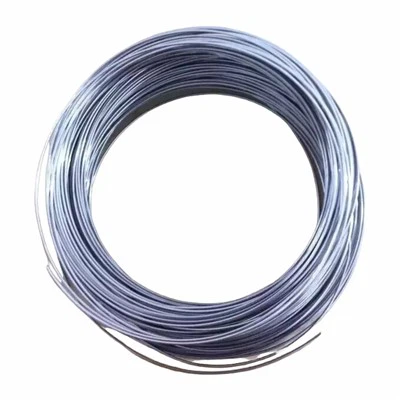
What is the Poisson's ratio of titanium wire?
As a supplier of titanium wire, I often encounter customers who are curious about various properties of titanium wire, and one frequently asked question is about the Poisson's ratio of titanium wire. In this blog post, I will delve into what the Poisson's ratio is, its significance for titanium wire, and how it impacts different applications.


Understanding Poisson's Ratio
The Poisson's ratio is a fundamental mechanical property that describes the relationship between the lateral strain and the longitudinal strain of a material when it is subjected to an external force. When a material is stretched or compressed in one direction, it will also deform in the perpendicular direction. The Poisson's ratio, denoted by the Greek letter ν (nu), is defined as the negative ratio of the transverse strain (ε_transverse) to the longitudinal strain (ε_longitudinal). Mathematically, it is expressed as:
ν = - ε_transverse / ε_longitudinal
The value of the Poisson's ratio ranges from -1 to 0.5 for most materials. A value of 0.5 indicates that the volume of the material remains constant during deformation, which is characteristic of an incompressible material. A negative Poisson's ratio is possible in some special materials known as auxetic materials, which expand laterally when stretched.
Poisson's Ratio of Titanium Wire
Titanium is a widely used metal due to its excellent properties such as high strength-to-weight ratio, corrosion resistance, and biocompatibility. The Poisson's ratio of titanium generally falls in the range of 0.32 - 0.34. This value is relatively consistent across different grades of titanium wire, including commercially pure titanium and titanium alloys.
The specific Poisson's ratio of a titanium wire can be influenced by several factors, such as the manufacturing process, heat treatment, and the presence of impurities. For example, a titanium wire that has undergone a cold-drawing process may have a slightly different Poisson's ratio compared to one that has been annealed. Additionally, the presence of alloying elements can also affect the Poisson's ratio. For instance, titanium alloys with higher amounts of certain elements may exhibit a different Poisson's ratio than pure titanium.
Significance of Poisson's Ratio for Titanium Wire Applications
The Poisson's ratio of titanium wire plays a crucial role in many applications. Here are some examples:
- Mechanical Engineering: In mechanical engineering applications, such as springs and fasteners, the Poisson's ratio affects the deformation behavior of the titanium wire. A higher Poisson's ratio means that the wire will experience more lateral deformation when subjected to a longitudinal force. This can impact the design and performance of mechanical components. For example, in a spring, the Poisson's ratio affects the spring rate and the amount of deflection under a given load.
- Medical Implants: Titanium is widely used in medical implants due to its biocompatibility. The Poisson's ratio of titanium wire is important in medical applications because it affects the stress distribution and the fit of the implant within the body. A proper understanding of the Poisson's ratio can help in designing implants that are more comfortable and have a better long-term performance. For our Gr23 Titanium Wire For Medical Implant According To ASTM F136, the Poisson's ratio is carefully considered to ensure the best performance in medical applications.
- Welding: When using Pure Titanium Welding Wire for welding, the Poisson's ratio affects the stress distribution in the welded joint. The different Poisson's ratios of the base metal and the welding wire can lead to residual stresses, which may affect the strength and durability of the welded structure. Understanding the Poisson's ratio can help in selecting the appropriate welding parameters and materials to minimize these issues.
Measuring the Poisson's Ratio of Titanium Wire
There are several methods to measure the Poisson's ratio of titanium wire. One common method is the uniaxial tensile test. In this test, a sample of the titanium wire is subjected to a controlled tensile force, and the longitudinal and transverse strains are measured using strain gauges or other measuring devices. The Poisson's ratio can then be calculated using the formula mentioned earlier.
Another method is the ultrasonic method, which is based on the propagation of ultrasonic waves in the material. The velocity of the ultrasonic waves is related to the elastic properties of the material, including the Poisson's ratio. By measuring the ultrasonic wave velocities in different directions, the Poisson's ratio can be determined.
Impact of Poisson's Ratio on Product Design
When designing products using titanium wire, the Poisson's ratio must be taken into account. For example, in the design of a titanium woven mesh, the Poisson's ratio affects the way the mesh deforms under load. A mesh with a higher Poisson's ratio may be more flexible and able to conform to irregular shapes. Our Titanium Woven Mesh is designed with the Poisson's ratio in mind to ensure optimal performance in various applications.
Conclusion
In conclusion, the Poisson's ratio of titanium wire is an important mechanical property that has a significant impact on its performance in various applications. As a titanium wire supplier, we understand the importance of this property and ensure that our products meet the required standards. Whether you are in the mechanical engineering, medical, or welding industry, understanding the Poisson's ratio of titanium wire can help you make better decisions in product design and material selection.
If you are interested in purchasing titanium wire or have any questions about its properties, including the Poisson's ratio, please feel free to contact us for further discussion and procurement. We are committed to providing high-quality titanium wire products and excellent customer service.
References
- Callister, W. D., & Rethwisch, D. G. (2011). Materials Science and Engineering: An Introduction. Wiley.
-ASM Handbook, Volume 1: Properties and Selection: Irons, Steels, and High-Performance Alloys. ASM International.