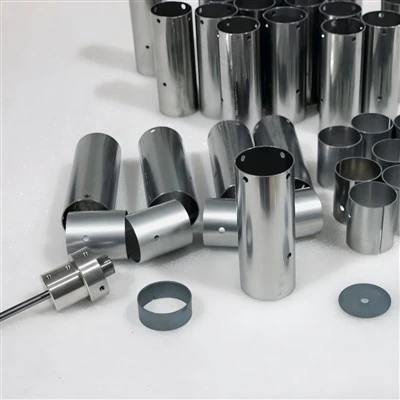
Titanium rod stress relief methods and application scenarios
Titanium rods will generate residual stress after processes such as cold drawing, rolling, forging, straightening, grinding, and machining. This residual stress can cause: bending deformation of the rod, warping after machining, storage deformation, and the risk of welding cracking.
Distinguishing two concepts:
1. Stress-relief annealing (Stress‑Relief Annealing): Only eliminates stress, does not completely recrystallize, and the hardness is basically retained.
2. Full annealing / Vacuum Annealing (Full Anneal / Vacuum Annealed): Both eliminates stress and refines the crystal grains, reduces hardness, and enhances plasticity.
Main methods for titanium rod stress relief
1. Vacuum stress relief annealing
Titanium materials must not be subjected to high-temperature heat treatment in air, as it will form an α-case rich in oxygen and prone to embrittlement.
Only vacuum furnaces can be used.
• Low-temperature stress relief (only eliminates stress, does not completely recrystallize)
Temperature: 480-590℃, vacuum holding, slow furnace cooling
◦ TA2 Gr2 pure titanium: commonly 500-550℃
◦ TC4 Gr5 titanium alloy: commonly 530-580℃
◦ Effect: Releases most of the residual stress; no significant recrystallization of crystal grains; little change in hardness and strength; limited improvement in plasticity.
◦ Application: Not wanting to significantly reduce the material's hardness and strength, only eliminating internal stress.
Vacuum full recrystallization annealing (fully eliminates stress + changes mechanical properties)
Vacuum full recrystallization annealing (fully eliminates stress + changes mechanical properties)
TA2 Gr2: 600-680℃; TC4 Gr5: 700-780℃ vacuum holding furnace cooling
◦ Stress almost completely released; crystal grains re-crystallize; hardness decreases, elongation and plasticity significantly increase.
◦ Market-sold annealed titanium rods are this process; the mainstream delivery state for marine welding base materials.
Key point: All titanium rod heat treatments must be in a vacuum environment; air heating will produce a surface brittle oxygen layer, which needs to be removed by grinding.
Mechanical stress relief (auxiliary means, cannot replace heat treatment)
1. Straightening (pressure straightening / rolling straightening)
Correcting bending through mechanical force; can only correct the shape, cannot eliminate internal residual stress, and may even add stress. Many suppliers claim the rods look straight after straightening, but the cutting machine processing will cause them to bend later, which is the root cause.
Only used for shape correction, not as a stress relief method.
2. Vibration aging VSR (vibration stress relief)
Applicable to titanium alloys to a small extent; applying resonant vibration to the workpiece to relax some residual stress.
• Limitations: This method is rarely used on a large scale in the titanium rod industry; the stress relief rate is not as good as vacuum annealing; for cold-processed titanium rods with high residual stress, the effect is limited; marine, shipbuilding projects by DNV/NORSOK generally do not recognize vibration aging as a substitute for stress relief annealing.
Summary: The only reliable and shipbuilding society-approved stress relief methods for titanium rods are: vacuum heat treatment (stress relief annealing / full annealing); mechanical straightening, vibration aging can only be auxiliary.
Scenarios where titanium rods must undergo stress relief treatment
Scenarios where stress relief / annealing must be done
1. Titanium rods after cold processing (cold drawing, cold rolling, extensive grinding)
Cold processing will accumulate high residual stress. After cutting and cutting, bending occurs; after customer machining and turning, the parts deform.
Exporters often encounter problems: suppliers only do straightening but not annealing, and the rods look straight when shipped, but after cutting, they bend.
2. Base materials for welding (marine, shipbuilding projects, KE Innovasjon AS, etc. Norwegian marine engineering)
• High-residual-stress base materials, welding adds welding stress, increasing the risk of cold cracking and deformation;
• DNV, NORSOK marine pressure-bearing components clearly require annealed delivery state (vacuum stress relief annealing);
• Cold-processed titanium rods without stress relief are not allowed to be directly used in pressure-bearing welding components.
3. Subsequent large allowance machining (turning, milling, deep cutting)
Residual stress inside the rod, after the surface material is removed, the stress re-balances, and the part warps or has size deviations. High-precision shafts and flange blanks must be stress relieved.
4. Parts requiring long-term dimensional stability
Finished rods / parts need to be stored and used for a long time and cannot undergo natural deformation. For example, marine connection parts, equipment shafts. Without stress relief, the rods will slowly bend after being stored for several months.
5. TC4 Gr5 titanium alloy forged rods
After forging, the residual stress is high. If no vacuum annealing is performed, subsequent processing is prone to deformation.
Consider the scenario of low-temperature stress relief (without complete recrystallization annealing)
The customer wants to retain high hardness and strength while eliminating stress:
For example, some spring-like parts and wear-resistant parts, they do not want the material to become soft, so they choose low-temperature vacuum stress relief (500-580℃), without complete high-temperature annealing.
Note: The plasticity improvement is limited; if subsequent pressure-bearing components need to be welded, priority should be given to complete recrystallization annealing.
Scenarios without additional stress relief required
1. Hot-rolled hot-forged titanium rods, produced under hot processing, are already at high temperature, and the residual stress is already very low; subsequent cold processing, no further deep processing, and no pressure-bearing component welding can be done, and there is no need for additional stress relief.
2. Simple cutting with small allowance, no machining, no welding, and low requirements for dimensional accuracy.
Risk reminder
Only mechanical straightening is performed, without vacuum annealing, the appearance is straight, but the internal stress is still very high, and the overseas marine project acceptance will have problems, NORSOK/DNV will not accept.
Contact person :Tracy
Our address
Baoji city, shaanxi province, China
Phone Number
(123)-456-789
hello@yourdomain.com