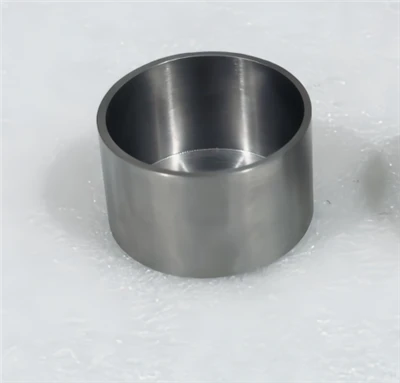
The Ultimate Trial of Fire and Strong Alkali: Micron-scale Creation Philosophy of Customized Ni 201 Welding Crucible

In extreme high-temperature chemical reaction fields, most metal containers will experience devastating intergranular corrosion or perforation failure within hours when potassium caustic (KOH) is molten at 850 °C. However, there is a container that can be as stable as a rock in this purgatory of "fire and strong alkali"-this is the Nickel 201 Welded Crucible made of low-carbon pure nickel.
From the non-standard geometric structures displayed in the drawings (such as the trapezoidal main body with optimized aspect ratio, the transition bottom with large fillet corners, and the advanced custom components with flange sealing holes), it can be seen that the synthesis of modern high-end chemical and new energy materials has great impact on the design of containers. It puts forward almost harsh artistic requirements. In order to achieve long-life and stable operation under ultra-high temperature strong alkali at 850 °C, its manufacturing and delivery management must break through the routine.
I. The red line of life and death in the production process: what should be paid attention to?
Ni 201 (UNS N02201) is a low-carbon version of pure nickel (carbon content C ≤ 0.02%). Its core advantage is that it can effectively prevent "caustic embrittlement" caused by carbide precipitation in the temperature range of 315 °C-650 °C or even higher. "and intergranular corrosion. But in the actual manufacturing process, any small process negligence will make the material advantage zero: Absolute "carbon-free" clean welding control:
Since the crucible adopts welding process (Welded Construction), the weld seam is a weak link in the overall structure. With TIG/GTAW welding, matching pure nickel wires (such as ERNi-1) must be used with strict back backing purging. Any carbon and sulfur contamination will induce severe local grain boundary brittleness at 850 ℃.
Stress Relief Annealing : Sheet shearing, bending forming (such as trapezoidal sidewall and fillet transition) and multi-faceted tailor welding will produce huge machining stresses and welding residual stresses. If strict high vacuum or protective stress relief annealing is not carried out, the crucible is prone to stress corrosion cracking (SCC) or geometric deformation when KOH molten salt is loaded at high temperature (850 ℃).
Geometric accuracy and thermal prediction: Combined with a variety of custom design drawings (such as an uncovered structure with a main body size of about 230 mm x 120mm x 140mm, or a composite component with a 310mm x 180mm precision mounting flange), it must be accurately reserved in production High temperature thermal coefficient compensation. The Fillet Radius at the bottom must be rounded to avoid stress concentration under a strong Thermal Shock.
II. The last hurdle to global buyers: what should be paid attention to when delivering?
For European and American high-end industrial buyers who have traveled across the ocean, what they receive is not only a metal container, but also the safety cornerstone of their entire high-temperature synthesis system. In the final delivery process, the following details must be controlled:
"Zero Grease" Ultimate Surface Passivation and Cleaning: Nickel is extremely sensitive to carbon. Before delivery, ultrasonic deep degreasing and chemical pickling must be carried out to ensure that the crucible is absolutely free of fingerprints, cutting oil or hydrocarbons. Even a small layer of organic residue will instantly carbonize and erode the nickel substrate at 850 °C KOH.
Full-process traceable document (MTC): A material certificate complying with EN 10204 3.1 standard must be accompanied by the goods, clearly indicating the ultra-low carbon content of Ni 201 (C ≤ 0. 02%), the ICP-MS impurity element analysis report, and the non-destructive inspection of the weld (such as PT penetrant inspection or radio graphic inspection) qualification record.
Rigid shock-proof and dust-free airtight packaging: Considering that large-capacity welding crucibles (such as structural parts with precision flanges) are extremely vulnerable to external force in long-distance sea or air transportation, resulting in flange deformation or diameter loss, the packaging must be customized high-density EPE pearl cotton for 1: 1 internal and external suspension fixation, the outer layer is put into a vacuum moisture-proof bag and packed into a fumigation-free solid wooden box that meets export standards.
III. Core Technical Parameters and Specifications
For your quick evaluation, the core physical and chemical indicators of this series of Ni 201 welding crucibles are sorted out as follows:
| Property | Specification | Advantages |
| Material Grade | Ni 201/UNS N02201 (low-carbon pure nickel) | Carbon content is controlled at ≤ 0. 02% to prevent high-temperature graphitization and intergranular embrittlement |
| Purity | Ni ≥ 99.0%, Fe ≤ 0.40%, C ≤ 0.02% | Exhibited excellent chemical stability in caustic solution |
| Density | 8.89 g/cm³ | High density, preventing molten KOH from penetrating into deep layers |
| Melting Point | 1435 ℃ – 1446 ℃ | Much higher than the actual working condition temperature of 850 ℃, ensuring the safety of high temperature structure |
| Thermal Conductivity | 76 W/(m·K) (at 20℃) | Conducts heat rapidly and uniformly, avoiding temperature differential stress caused by local overheating |
| Design Type | Trapezoidal welding structure, large fillet transition bottom, optional high pressure sealing flange | Different volume requirements and high temperature reaction furnace flange docking standards |
| Manufacturing and Acceptance Standards | ASTM B162/ASME SB-162/TIG Welding Specifications | Meet European and American Access Standards for Pressure Vessel and High Temperature Laboratory Equipment |