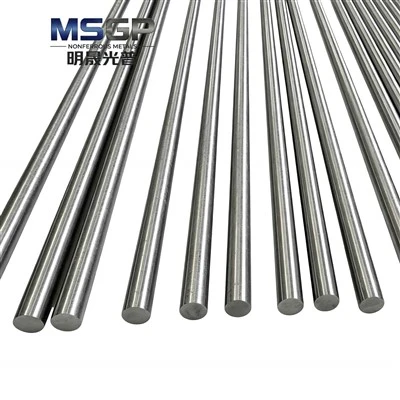
Why are thick-walled molybdenum pipes better able to withstand deformation under high temperature and high pressure?
Many engineers who do hot isostatic pressing or high-temperature reactors have encountered the same problem: the tube is measured to be normal at room temperature, and once it rises above 1,500 degrees Celsius and is put under pressure, the parts with thin wall thickness will start to bulge or elongate. Although the melting point of molybdenum is high, the creep problem will gradually appear when it is in a state of high-temperature stress for a long time. At this time, the wall thickness is no longer just "enough", but directly determines the safety margin and service life.
The advantages of thick-walled molybdenum tubes are reflected here. Thicker pipe walls can disperse stress over a larger cross-sectional area, significantly bearing load per unit area, thereby reducing the creep rate. In practice, when the wall thickness of a pipe with the same outer diameter is increased from two millimeters to five or six millimeters, the deformation can be significantly reduced under the same temperature and internal pressure conditions, and the roundness can still be maintained even after hundreds of hours of continuous operation. Alloying (such as TZM with titanium-zirconium addition) can further improve the high-temperature strength, allowing the thick-walled structure to last for a period of time under more stringent working conditions.
This characteristic is especially practical in high-temperature pipelines and pressure-bearing components of hot isostatic pressure furnaces in the chemical industry. In the past, some imported thin-walled schemes had partial bulges after a period of time, and had to be replaced in advance; After replacing with thick-walled molybdenum pipes, the maintenance cycle can often be lengthened a lot. Of course, the thicker the wall thickness, the better; too thick will cause weight and cost, and it will also slow down heat conduction. The reasonable method is to deduce the minimum wall thickness according to the actual temperature, pressure, and expected life, and then set aside a certain safety factor.
Surface machining and dimensional tolerances also cannot be ignored. If the concentricity of the inner and outer circles of thick-walled tubes is not well controlled during machining, the thicker places will be thicker, and the thinner places will be thinner, which will instead form stress concentration under high pressure. Now the country has been able to achieve a relatively uniform wall thickness and surface for large-sized thick-walled molybdenum pipes, and the sealing and matching accuracy are more guaranteed during assembly.
When selecting thick-walled molybdenum pipes, considering the working temperature, pressure fluctuation range, and continuous operation time together is often more reliable than simply looking at wall thickness figures. If you are picking pipes for a high-temperature and high-pressure project, you might as well list these parameters clearly first. Many seemingly difficult deformation problems can actually be solved by the combination of wall thickness and alloy.
NAME
Ava