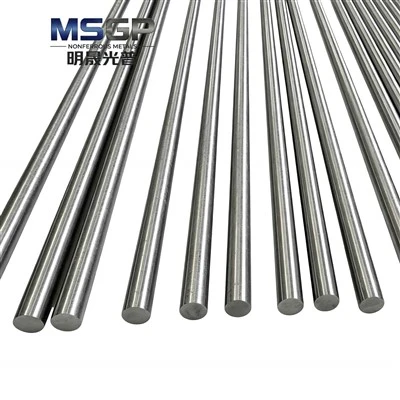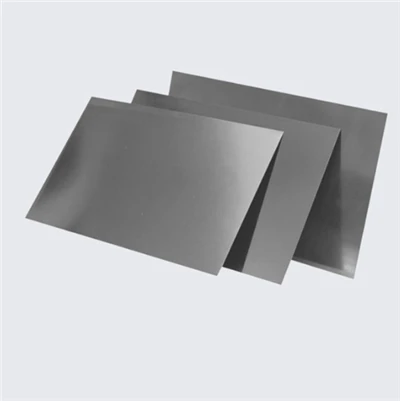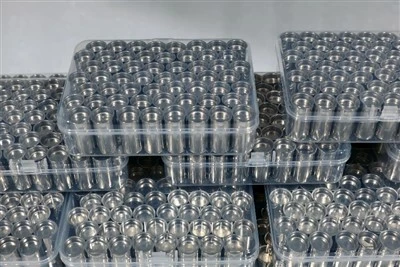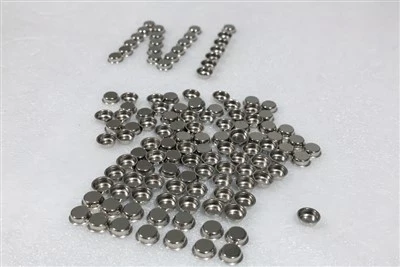
Stamped niobium crucibles are manufactured by deep drawing high-purity niobium sheet into seamless cups, widely used in rare earth smelting, high-temperature sintering, synthetic diamond production, and superconducting accelerator cavities. Compared with machined crucibles, stamping offers higher material utilization, superior mechanical properties, and better dimensional accuracy, making it particularly suitable for batch production of small to medium-sized crucibles. However, forming niobium is far from ordinary metal stamping. The challenges stem from niobium's intrinsic characteristics as a body-centered cubic (BCC) refractory metal, amplified through every stage of process execution into a systematic technical barrier spanning metallurgical quality to forming control. So, what exactly are the processing challenges of stamping niobium crucibles?
Cold-rolled niobium sheet exhibits pronounced plastic anisotropy. Research on 99.95% pure, 1.02 mm thick cold-rolled niobium shows that the plastic strain ratio (r-value) is only 1.2 at 45° to the rolling direction but reaches 2.5 at 90°, a difference exceeding twofold. This in-plane anisotropy directly causes "earing" during deep drawing-a wavy, uneven rim profile on the drawn cup. Earing not only wastes expensive niobium material but, more critically, leaves the low-ear regions under higher circumferential residual tensile stress, potentially leading to "delayed cracking" days after forming and causing field failures. Consequently, blank design for niobium crucible stamping cannot simply use circular blanks; non-circular anisotropic blanks based on r-value distribution are required to balance flow resistance in different directions.
The grain size of niobium sheet has a decisive influence on forming quality. Coarse-grained structures deform grain-by-grain during deep drawing, producing an "orange peel" effect that roughens the crucible's inner wall. For synthetic diamond crucibles, this roughness transfers directly to the finished product, substantially increasing downstream grinding costs. More critically, coarse grains reduce uniform elongation capacity, making crack initiation at grain boundaries and propagation into tears highly likely during deep drawing. The annealing temperature window for niobium is closely tied to impurity content: molybdenum above 3% can raise the annealing temperature to 1200°C, while boron at 0.8–1% can lower it to 1030–1000°C. This means that even within the same grade, variations in trace elements demand different annealing schedules to achieve the fine grain structure necessary for successful stamping.
Niobium's hardness evolution during cold deformation is non-linear: within 25% strain, Vickers hardness rises rapidly from 84 to approximately 120; between 25% and 60%, the change slows; beyond 60%, hardness increases significantly again. This characteristic imposes precise strain allocation requirements across drawing passes. Excessive strain per pass hardens the material rapidly, making subsequent passes prone to cracking; insufficient strain necessitates additional annealing cycles, which in turn risk grain coarsening-trapping the process in a "hardening–annealing–coarsening" vicious cycle. In practice, intermediate annealing of stamped niobium crucibles is typically performed in vacuum (not lower than 10⁻⁵–10⁻⁴ mmHg) at 800–1000°C to relieve internal stress and restore ductility, but small deviations in annealing parameters can alter the forming behavior of the final product.
4: Challenge Four: Friction and Adhesion-The Surface Quality Bottleneck
Niobium exhibits a strong tendency to adhere to tooling materials through friction. During deep drawing, contact regions between the niobium sheet and die can undergo atomic-level diffusion "galling" causing surface scratching or even localized tearing. Research indicates that defect rates in cold stamping of refractory metals can reach as high as 50%, with inadequate friction control being a major contributor. The inner wall surface quality of niobium crucibles is critical to their performance-whether for rare earth melting or diamond synthesis, scratches or roughness on the inner surface affect material flow and product quality. Die materials are therefore typically aluminum or copper alloys to reduce adhesion risk, and the use of lubricants (such as graphite emulsion) together with die surface finish maintenance constitutes another key process control challenge.
In summary, the processing challenges of stamping niobium crucibles are not isolated but form a complete chain from metallurgical quality to forming parameters: grain size determines surface quality, anisotropy dictates blank design and defect susceptibility, work-hardening behavior governs pass planning, and friction behavior controls surface integrity. Failure at any link can result in scrap rates as high as 50%. Successful niobium crucible stamping is, in essence, a systematic understanding and precise control of this entire chain.
Name
Lisa
Phone Number/weChat/whatsApp
(86)-18291772322
Ta-Nb@titanmsgp.com