Industry cutting-edge insights: Breaking through the micron-level bottleneck, how can precision weld treatment empower extreme metal crucibles?

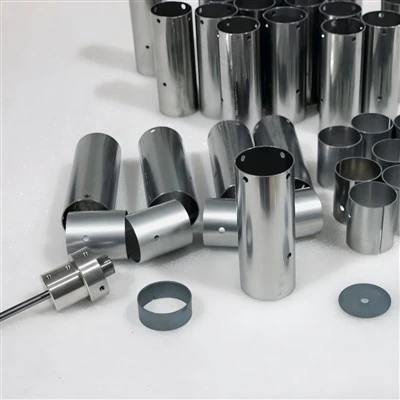
In the fields of high-temperature vacuum metallurgy, semiconductor thin film deposition and high-end chemical analysis, metal crucibles, as the core bearing vessels, have always had extremely stringent requirements on material purity and structural strength. However, as shown by related precision welding processes and products, the success or failure of many refractory metal and non-ferrous metal crucibles that are tailor-welded by reels and bases often does not depend on the large-area body plate, but on the extremely critical "weld treatment technology".
Since then, when welding crucibles are faced with ultra-high temperature (such as above 1000 °C) thermal cycles or strongly corrosive molten salts, the weld seam area has often become the "Achilles' heel" of structural failure. Due to local grain coarsening micro-pores and residual stress concentration caused by welding heat input micro-cracks are easily generated in the weld under Thermal Shock (Thermal Shock) and even lead to catastrophic leakage of precious melt.
Technological Breakthrough: A Technological Revolution from "Weldable" to "Flawless"
In order to overcome the pain point of this industry, the manufacturing of modern high-end refractory metal containers is undergoing a profound innovation in weld treatment technology. Its core logic is mainly reflected in three dimensions:
High energy density precision welding: Instead of extensive welding, electron beam welding (EBW) or high-purity shielding gas micro-beam TIG welding is used. This makes the weld penetration narrow, the heat affected zone (HAZ) is compressed to the limit, from the source of gas inclusions and oxidation tendency.
Strict vacuum stress relief annealing: Welding is not the end of the process. High-quality crucibles must undergo strict high-temperature vacuum annealing after welding to completely eliminate welding residual stress, make the micro-structure of the weld zone consistent with the base metal, and greatly improve creep and tensile resistance.
Mirror grade weld transition and passivation treatment: Through fine mechanical polishing and chemical pickling, the residual height of the weld is reduced to the lowest level, and the stress concentration point caused by the sudden change of surface micro geometry is eliminated.
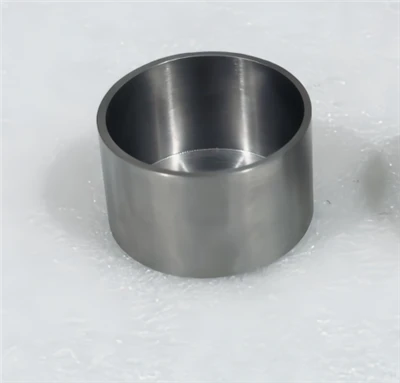
As shown in the picture, the optimized precision welding crucible not only presents a mirror-like metallic luster on the surface, but also has dense, uniform and transitional welds in the longitudinal and bottom directions. This level of process ensures that the vessel has excellent permeability resistance and long-term thermal stability in ultra-high vacuum (UHV) and extreme chemistry.
Future Outlook of the Industry
Today, with the accelerated iteration of new energy, advanced semiconductors and materials, the refinement of welding processes has become a touchstone to measure the core competitiveness of rare metal processing plants. Weld seam treatment is by no means a simple "connection" process, but a lifeline related to the safe operation of the entire extreme thermal field. With the further upgrading of micro-and nano-scale welding monitoring and heat treatment technology, high-reliability welding crucibles are reshaping the standard of high-end industrial containers with more perfect structural performance.