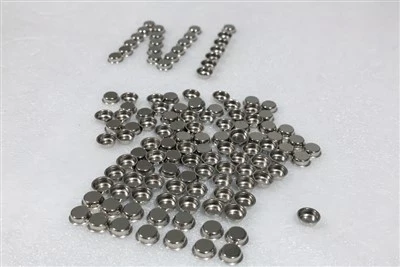
How Can Gr5 Do Mirror Polishing!?

Commonly used polishing methods for metal materials include mechanical polishing, chemical polishing and electrolytic polishing. For titanium and its alloys, mechanical polishing and electrolytic polishing are commonly used in laboratories and industries at present. The mechanical polishing parameters mainly depend on the hardness of the material. The hardness of titanium and its alloys is similar to that of medium and low carbon steel, and its grinding and polishing efficiency is similar to that of steel. For the commonly used Gr5 (i.e. Ti-6Al-4V) alloy, both mechanical and electrolytic polishing can be done, and both of them have their own characteristics. All need to be ground before polishing.
I. Grinding
The surface should be ground to 4000 # (or 5000 #) sandpaper before polishing. Grades of sandpaper used in general grinding include 240, 400, 600, 1000, 1500, 2000, 4000 (5000 or 3000).
In the process of manual grinding, pay attention to grinding the surface unidirectionally along one direction, and the scratches are in a single direction. When the scratches completely cover the scratches produced by a piece of sandpaper, it can be considered that the number of sandpaper has been ground. The automatic grinding and polishing machine usually takes 2 to 3 minutes for No. 1 sandpaper.
During the grinding process, it is best to wash with running water at the same time to remove the sand and metal particles generated during the grinding process. At the same time, when changing the sandpaper, the surface of the sample must be washed clean.
For sandpaper brands, generally domestic sandpaper before 2000 can be required, 4000 (5000 or 3000) sandpaper can only be produced by a small number of domestic sandpaper manufacturers, some domestic 3000
II. Mechanical polishing
For titanium alloys, short-pile polishing cloth is generally used for mechanical polishing. Polishing fluid is generally based on softer materials, such as iron red (iron trioxide), silica suspension.
For iron red, it is generally necessary to adjust it into a yogurt shape with water first, and then smear it on a polishing cloth at a speed of 600-800 rpm. There is basically no need to add water during the polishing process. When iron red is semi-dry, the polishing efficiency can basically remove visible scratches on the surface in about 5 minutes. Then wash the polishing cloth, use the aqueous solution of chromium trioxide (chromic acid, generally 200 ml of water and put two passes of three small pieces of chromium trioxide) as a polishing agent, and carry out fine polishing until the surface is completely scratched. Although the polishing efficiency is very high, the iron red is very dirty. Generally, after we finish polishing, the entire work clothes, polishing machine and its surroundings are covered with red iron red, which looks like a crime scene.
III. Electrolytic polishing
Electropolishing of titanium alloys has a variety of process options. We generally use room temperature and high pressure polishing. The polishing solution is 5: 95 perchloric acid: acetic acid solution, with stainless steel electrode as the negative electrode. The polishing voltage is 60-70V, and the time is 10-15s. During the polishing process, the sample is shaken, and immediately washed after polishing. Parameters such as time and voltage of electrolytic polishing need to be carried out according to the specific sample size, which is accidental. However, the polishing efficiency is high, and the polished surface is stress-free, which can be observed by EBSD. When electrolytic polishing, the surface is ground to 2000, of course 4000 polishing is better.