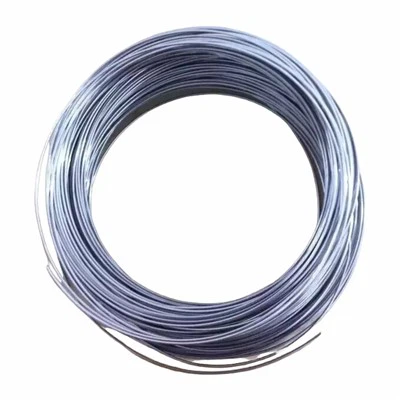

Superconductivity is a fascinating phenomenon that has the potential to revolutionize various industries, from energy transmission to medical imaging. Niobium wire, in particular, is a promising material for achieving superconductivity due to its unique properties. As a niobium wire supplier, I am excited to share with you the process of making niobium wire superconducting.
Understanding Superconductivity
Before delving into the process of making niobium wire superconducting, it's essential to understand what superconductivity is. Superconductivity is a state in which a material exhibits zero electrical resistance and expels magnetic fields when cooled below a certain critical temperature (Tc). This phenomenon was first discovered in 1911 by Heike Kamerlingh Onnes, who observed that mercury lost all electrical resistance when cooled to 4.2 Kelvin (-268.95°C).
The critical temperature is a crucial parameter in superconductivity. Different materials have different critical temperatures, and the goal is to find materials with higher critical temperatures to make superconducting applications more practical. Niobium has a relatively high critical temperature of about 9.2 Kelvin (-263.95°C), making it a popular choice for superconducting applications.
The Properties of Niobium Wire
Niobium is a transition metal with several properties that make it suitable for superconducting applications. It has a high melting point (2468°C), good ductility, and excellent corrosion resistance. These properties allow niobium wire to be easily fabricated into various shapes and sizes, making it ideal for use in superconducting magnets, cables, and other devices.
In addition to its physical properties, niobium also has unique electronic properties. It has a relatively high density of states at the Fermi level, which is important for achieving superconductivity. The electrons in niobium can form Cooper pairs, which are pairs of electrons that move through the material without resistance. This phenomenon is the basis of superconductivity.
The Process of Making Niobium Wire Superconducting
The process of making niobium wire superconducting involves several steps, including purification, fabrication, and cooling. Here is a detailed overview of each step:
Purification
The first step in making niobium wire superconducting is to purify the niobium. Impurities in the niobium can significantly affect its superconducting properties, so it's essential to remove as many impurities as possible. This is typically done through a process called electron beam melting, which involves heating the niobium in a vacuum using an electron beam. The high temperature causes the impurities to vaporize, leaving behind pure niobium.
Fabrication
Once the niobium is purified, it is fabricated into wire. This is typically done through a process called drawing, which involves pulling the niobium through a series of dies to reduce its diameter. The drawing process can be repeated several times to achieve the desired wire diameter.
During the drawing process, it's important to control the temperature and strain rate to ensure that the wire has the desired properties. The wire should be annealed at regular intervals to relieve stress and improve its ductility.
Cooling
The final step in making niobium wire superconducting is to cool it below its critical temperature. This is typically done using a cryogenic cooling system, such as a liquid helium or liquid nitrogen bath. The cooling system must be able to maintain a constant temperature below the critical temperature to ensure that the wire remains superconducting.
Applications of Superconducting Niobium Wire
Superconducting niobium wire has a wide range of applications in various industries. Here are some of the most common applications:
Superconducting Magnets
One of the most significant applications of superconducting niobium wire is in the production of superconducting magnets. These magnets are used in a variety of fields, including medical imaging (MRI), particle accelerators, and magnetic levitation trains. Superconducting magnets can generate much stronger magnetic fields than conventional magnets, making them ideal for these applications.
Power Transmission
Superconducting niobium wire can also be used for power transmission. Since superconducting materials have zero electrical resistance, they can transmit electricity without any loss of energy. This makes them ideal for long-distance power transmission, where energy losses can be significant.
Sensors
Superconducting niobium wire can be used to make highly sensitive sensors. These sensors can detect very small changes in magnetic fields, making them useful in a variety of applications, including geophysical exploration, non-destructive testing, and biological imaging.
Our Niobium Wire Products
As a niobium wire supplier, we offer a wide range of niobium wire products, including Nb1 Niobium Wire. Our niobium wire is made from high-purity niobium and is available in various diameters and lengths. We can also customize the wire to meet your specific requirements.
Our niobium wire is suitable for a variety of applications, including superconducting magnets, power transmission, and sensors. We are committed to providing high-quality products and excellent customer service. If you are interested in purchasing niobium wire, please contact us to discuss your needs.
Conclusion
Making niobium wire superconducting is a complex process that involves purification, fabrication, and cooling. However, the potential benefits of superconducting niobium wire are significant, including improved energy efficiency, stronger magnetic fields, and more sensitive sensors. As a niobium wire supplier, we are committed to providing high-quality products and helping our customers achieve their superconducting goals.
If you are interested in learning more about our niobium wire products or have any questions about making niobium wire superconducting, please contact us. We look forward to working with you to explore the exciting world of superconductivity.

References
- Ashcroft, N. W., & Mermin, N. D. (1976). Solid State Physics. Holt, Rinehart and Winston.
- Tinkham, M. (1996). Introduction to Superconductivity. Dover Publications.
- Cava, R. J. (2004). High-Temperature Superconductivity. Annual Review of Materials Research, 34(1), 589-621.