

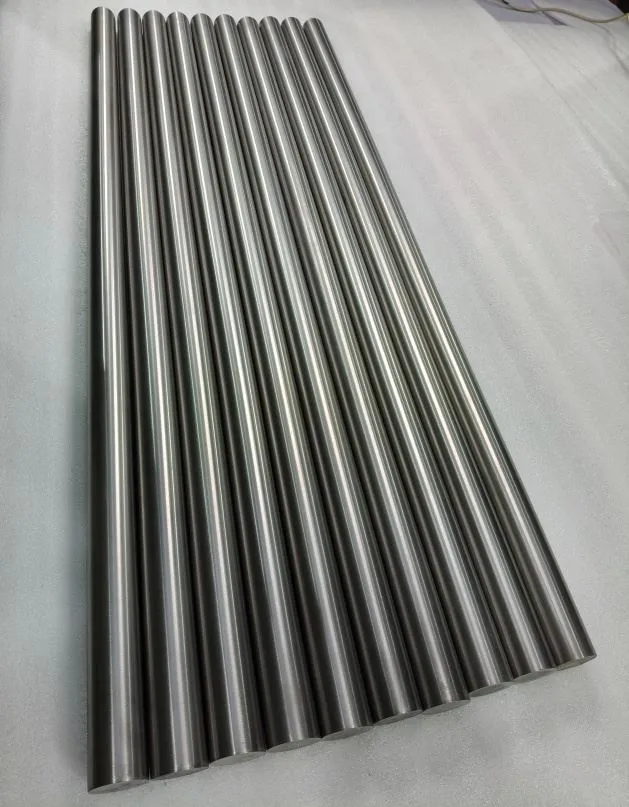
Material Characteristics

N6 pure nickel rod is an industrial pure nickel product with a nickel (Ni + cobalt, Co) content of not less than 99.5%. It implements the GB/T 4435-2010 national standard and is widely used in chemical equipment, electronic component manufacturing, and other fields at home and abroad. The material is famous for its silver-white metallic luster appearance, with a density of 8.89 g/cm³ and a melting point of approximately 1440–1455°C. It is a basic metal material with excellent corrosion resistance and good processing properties.
In the industrial material system, the N6 pure nickel rod plays an irreplaceable role. It neither relies on chromium to form a passivation film like stainless steel, nor does it rely on high electrical conductivity like copper alloys. Instead, it achieves an excellent balance between resistance to strong alkali corrosion, electrical and thermal conductivity, and comprehensive mechanical properties. N6 pure nickel rods can be processed into different sizes through hot rolling, forging, cold drawing, and other processes to meet the customized needs of various industrial equipment. The surface of the rod can be provided in various states, such as pickling, polishing, or machine processing. The delivery length ranges from 1000 mm to 6000 mm, and the diameter range covers Φ6 mm to Φ200 mm.
N6 pure nickel rod corresponds to the American standard UNS N02200 (Nickel 200) in the international material grade system and is highly compatible with the ASTM B160 standard. This means that customers purchasing N6 pure nickel rods can seamlessly meet the requirements for material performance and quality verification in the European and American markets, without the need for additional standard conversion or repeated certification. For export-oriented OEM manufacturing companies, this feature greatly simplifies the compliance chain from raw material procurement to end product export.
With excellent comprehensive properties, N6 pure nickel rods are widely used in chlor-alkali chemicals, new energy batteries, aerospace, electronics, and other fields, and are a highly favored high-performance basic material in the industrial manufacturing field.
Products Parameters
| Product Name | N6 Pure Nickel Rod |
| Purity | Ni+Co≥99.5 |
| Thickness | Φ6 mm – Φ200 mm/customized |
| Length | 1000 mm – 6000 mm/customized |
| Surface State | Pickled state/polished state/machined state/hot rolled state |
| Tolerance | +-0.05mm |
| Delivery Status | Hot rolled rod / forged rod / cold drawn rod |
| Optimum temperature for thermal processing | 1000–1100℃ |
| Annealing temperature | 700–900℃ (in protective atmosphere) |
| Cold working elongation up to | 50% |
| Density | 8.89 g/cm³ |
| Melting point | 1435–1455℃ |
| Thermal conductivity | 70–90 W/(m·K) |
| Resistivity (20℃) | 0.086 μΩ·m |
| Linear expansion coefficient | 13.5×10⁻⁶/K |
| Curie point | 360°C |
| Modulus of elasticity | 177–207 GPa |
| Tensile strength | ≥380 MPa |
| Yield strength | ≥100 MPa |
| Elongation | ≥35%–40% |
| Hardness (hot rolled) | 45–80 HRB |
| Hardness (annealed) | 45–75 HRB |
Products Advantages
Excellent resistance to strong alkali corrosion
The core technical advantage of the N6 pure nickel rod lies in its excellent resistance to caustic media. In strong alkaline environments such as sodium hydroxide (NaOH) and potassium hydroxide (KOH), N6 nickel rods are almost not corroded by any concentration or temperature (until the molten state). Taking 50% NaOH solution under boiling point conditions as an example, its annual corrosion rate is less than 0.05 mm, and its performance far exceeds that of 304, 316, and other stainless steel materials. This characteristic makes it the best choice for key equipment such as evaporators and concentration tanks in the chlor-alkali industry. In seawater, neutral salt solutions, and fresh water environments, N6 also exhibits extremely low corrosion rates and is suitable for long-term service requirements in the fields of marine engineering and shipbuilding.
Excellent electrical and thermal conductivity
The electrical and thermal conductivity properties of pure nickel are among the best among commonly used metal materials. The resistivity of the N6 pure nickel rod is about 0.086 μΩ·m (20℃), and the conductivity reaches 98% IACS, which is much higher than that of stainless steel and other materials. At the same time, its thermal conductivity is about 70–90 W/(m·K), which is about twice that of carbon steel. It has natural material advantages in heat exchangers and thermal conductive components. This makes N6 pure nickel rods favored in the fields of high-frequency conductive parts, vacuum tube filaments, relay contacts, and other electronic components.
Excellent processing and welding performance
N6 pure nickel rod has a face-centered cubic crystal structure without allotropic transformation, and its structure is stable in the full temperature range from low temperature to high temperature. The annealed elongation can reach 35%–45%, it can be rolled to 0.01 mm ultra-thin foil, and it has excellent cold and hot processing properties. In terms of welding, it is recommended to use tungsten inert gas welding (TIG/GTAW) and use ERNi-1 nickel-based welding wire to obtain excellent weld quality.
Unique magnetic properties
N6 pure nickel has significant ferromagnetism at room temperature, with a Curie point of about 360°C. This characteristic makes it have special application value in electronic devices such as electromagnetic shielding components and magnetron isolation rings.
Strict impurity control
N6 pure nickel rod needs to strictly control the impurity content during the production process, and implement the dual standards of GB/T 4435-2010 and ASTM B160. Carbon content ≤0.10%, iron ≤0.40%, sulfur ≤0.01%, silicon ≤0.35%, lead ≤0.002%, bismuth ≤0.002%. Strict impurity control ensures material performance stability and application reliability.
Products Applications
The chlor-alkali industry is the largest application field of N6 pure nickel rods. In the ion membrane caustic soda production process, N6 nickel rods are widely used to make key components such as evaporators, concentration tanks, reactor linings, pipeline valves, and chlor-alkali production electrodes. High-temperature concentrated alkali (NaOH 50%, 150°C) is highly corrosive to carbon steel. Stainless steel will also undergo alkali embrittlement fracture in this environment. Only nickel materials can serve stably for a long time. In addition, N6 nickel rods also play an irreplaceable role in equipment for processing organic chlorides, fluorides, and transporting HF (anhydrous hydrofluoric acid).
In the context of the rapid development of new energy vehicles and energy storage industries, N6 pure nickel rods play an important role in the manufacturing of lithium batteries and nickel-metal hydride batteries. N6 nickel rods can be customized into ultra-thin strips with a thickness of 0.03 mm and are used for lithium battery connectors. They are also an important raw material for alkaline fuel cell electrode materials and energy storage battery current collectors. They use their dual properties of conductivity and alkali resistance to provide key material support for the development of the new energy industry.
N6 pure nickel rod has become an ideal functional material in the electronic and electrical field due to its high purity, low resistivity, and excellent electromagnetic properties. N6 nickel rods are used to make vacuum electronic device sealing parts, magnetron isolation rings, high-precision resistor substrates, spark plug electrodes, relay contacts, and other special components. In the aerospace field, N6 materials are used in components such as rocket engine ignition devices, spacecraft temperature sensor sheaths, and some alkali-resistant valves and high-temperature-resistant fasteners.
N6 pure nickel rod has excellent corrosion resistance to seawater and is stable against seawater and salt solutions at room temperature. It is widely used in corrosion-resistant components of seawater desalination units, ship propulsion system components, and ship piping systems. Compared with commonly used stainless steel, N6 almost does not suffer from stress corrosion cracking caused by chloride ions, and has greater long-term service reliability in high salt spray corrosion environments such as the ocean.
Product Packaging


In order to protect the n6 pure nickel bar from damage during transportation, we will first wrap the nickel bar with plastic wrap to prevent scratches due to friction between the bars, and then use foam buffering materials to wrap all the n6 nickel bars to buffer the impact during transportation. Finally, use thick foam to fill the top left and right to prevent shaking during transportation.
Comparison between N4 and N6 nickel rods
N4 has higher purity, the nickel plus cobalt content is not less than 99.9%, and it is a low-carbon pure nickel. Its carbon content is controlled at an ultra-low level of ≤0.01%, iron ≤0.10%, copper ≤0.05%, silicon ≤0.05%, and sulfur ≤0.005%. The nickel content of N6 is ≥99.5%, the carbon content is ≤0.10%, and the impurity control is relatively loose, with iron ≤0.40%, copper ≤0.25%, silicon ≤0.35%, and sulfur ≤0.01%.
The difference in carbon content is the most essential difference between the two. The ultra-low carbon content of N4 ensures that graphite carbides will not precipitate at the grain boundaries when serving in high temperature environments above 315°C and in carbon-containing atmospheres. Therefore, it has better material stability in higher temperatures or precipitation-sensitive environments. The carbon content of N6 is relatively high, but this also makes its corrosion resistance in strong alkali and salt solution media more prominent.
In the annealed state, the tensile strength of N4 is usually 350–450 MPa, the yield strength is ≥70 MPa, the elongation after fracture is not less than 40%, and the hardness (Brinnell) is about 80–110. The tensile strength of N6 is ≥380 MPa, the yield strength is ≥100 MPa, and the elongation is ≥35%–40%. The strength indicators of the two are similar, but N6 has a wider tensile strength range (370–540 MPa) and higher hardness, which makes it more advantageous in scenarios that bear larger mechanical loads.
3. Physical properties and high temperature performance
The density of the two is similar (about 8.89 g/cm³), and the melting point is about 1435–1455°C. The thermal conductivity of N4 (approximately 90.9 W/(m·K)) is slightly higher than that of N6 (approximately 70–90 W/(m·K)), and the heat dissipation performance is better. In terms of high-temperature performance, N4 has extremely low carbon content and is more resistant to graphitization in environments above 315°C, making it suitable for higher temperature conditions; N6 is recommended for use in alkaline and neutral environments below 315°C, and its long-term service stability is fully guaranteed.
4. Differences in application scenarios
Based on the differences in material properties, N4 is more suitable for high-precision electronic components (such as vacuum devices, electrode brackets), aerospace high-temperature equipment, and nuclear power components with extreme purity requirements. N6, with its irreplaceable corrosion resistance in strong alkali environments and more competitive cost performance, has become the mainstream material of choice for chemical equipment pipelines, storage tanks, reactors, and chlor-alkali industrial equipment. In terms of international brand benchmarking, N4 corresponds to the American standard UNS N02201 (Nickel 201), and N6 corresponds to the American standard UNS N02200 (Nickel 200). Both have clear positions in the ASTM and EN standard systems.
5. Differences in application scenarios
Generally speaking, N6 and N4 are not simply good or bad, but differentiated products for different working conditions and requirements. When choosing N6 or N4, factors such as service environment temperature, medium type (especially the presence or absence of oxidants), stress state, and cost budget need to be comprehensively considered. For most chemical, chlor-alkali, and marine engineering applications, N6 pure nickel rods are sufficient to meet the requirements and have better cost-effectiveness; while for high-temperature (>315°C) environments or precision electronics and aerospace fields that have extremely high requirements for intergranular corrosion, N4 is a more secure choice.
Contact Us
We have mature batch supply capabilities, and can purchase small batches for small and medium-sized enterprises, and large-scale order needs of large enterprises.
So if you need N6 pure nickel rods, then contact us now to get the latest quotation.
Phone Number/WhatsApp/WeChat
(86)-18291772322
Ta-Nb@titanmsgp.com

Hot Tags: n6 pure nickel rod, China n6 pure nickel rod manufacturers, suppliers, factory


