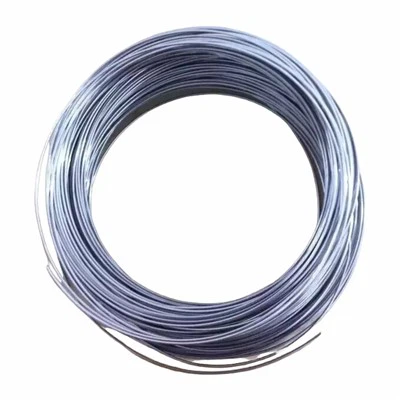

As a tantalum wire supplier, I've witnessed firsthand the importance of high - quality tantalum wire in various industries, from electronics to aerospace. Tantalum wire is known for its excellent corrosion resistance, high melting point, and good ductility. However, in many applications, there is a continuous demand to improve its mechanical properties to meet more stringent requirements. In this blog, I'll share some effective ways to enhance the mechanical properties of tantalum wire.
1. Alloying
One of the most common methods to improve the mechanical properties of tantalum wire is through alloying. By adding certain elements to tantalum, we can significantly change its microstructure and, consequently, its mechanical performance.

-
Addition of Refractory Metals: Elements such as tungsten (W), molybdenum (Mo), and niobium (Nb) are often added to tantalum. Tungsten, for example, has a high melting point and can increase the strength of tantalum wire at high temperatures. When tungsten is added to tantalum, it forms a solid - solution alloy. The tungsten atoms dissolve in the tantalum lattice, causing lattice distortion. This distortion makes it more difficult for dislocations to move, thereby increasing the strength of the material.
-
Addition of Rare - Earth Elements: Rare - earth elements like yttrium (Y) and lanthanum (La) can also be beneficial. These elements can refine the grain size of tantalum. A finer grain size leads to an increase in the grain boundary area. Since grain boundaries impede the movement of dislocations, a finer - grained structure results in higher strength and better ductility. For instance, the addition of a small amount of yttrium can improve the high - temperature strength and oxidation resistance of tantalum wire.
2. Heat Treatment
Heat treatment is another crucial process for improving the mechanical properties of tantalum wire.
-
Annealing: Annealing is a heat treatment process that involves heating the tantalum wire to a specific temperature and then cooling it slowly. This process can relieve internal stresses that are generated during manufacturing processes such as drawing. By relieving these stresses, the ductility of the tantalum wire is improved. For example, stress - relief annealing at a relatively low temperature (around 600 - 800°C) can reduce the residual stresses in the wire, making it more malleable and less prone to cracking during further processing.
-
Solution Treatment and Aging: Solution treatment involves heating the tantalum alloy to a high temperature to dissolve the alloying elements in the tantalum matrix. After that, the wire is quenched rapidly to retain the supersaturated solid solution. Subsequently, aging is carried out at a lower temperature. During aging, the alloying elements precipitate out of the solid solution, forming fine particles. These precipitates act as obstacles to dislocation movement, thereby increasing the strength of the tantalum wire.
3. Cold Working
Cold working is a process in which the tantalum wire is deformed at room temperature. This process can significantly increase the strength of the wire.
-
Drawing: Drawing is a common cold - working process for tantalum wire. When the wire is drawn through a die, its cross - sectional area is reduced, and the length is increased. This deformation causes dislocations to multiply and entangle within the material. The interaction between dislocations makes it more difficult for them to move, resulting in an increase in strength. However, cold working also reduces the ductility of the wire. To restore ductility, subsequent annealing may be required.
-
Rolling: Rolling is another cold - working method. Similar to drawing, rolling deforms the tantalum wire, increasing its strength. The degree of deformation during rolling can be controlled by adjusting the roll gap and the number of passes.
4. Microstructure Control
Controlling the microstructure of tantalum wire is essential for improving its mechanical properties.
-
Grain Size Control: As mentioned earlier, a finer grain size generally leads to better mechanical properties. By carefully controlling the processing parameters during manufacturing, such as the cooling rate during solidification and the heat - treatment conditions, we can achieve a desired grain size. For example, rapid cooling during solidification can result in a finer grain structure.
-
Texture Control: Texture refers to the preferred orientation of grains in a material. In tantalum wire, controlling the texture can have a significant impact on its mechanical properties. For instance, a specific texture can enhance the strength in a particular direction. This can be achieved through processes such as rolling and drawing with specific deformation conditions.
5. Surface Treatment
Surface treatment can also play a role in improving the mechanical properties of tantalum wire.
-
Coating: Applying a coating on the surface of the tantalum wire can protect it from corrosion and improve its wear resistance. For example, a ceramic coating can provide a hard and protective layer on the wire surface. This not only enhances the mechanical performance but also extends the service life of the wire.
-
Shot Peening: Shot peening is a process in which small spherical particles are shot at the surface of the tantalum wire. This creates compressive stresses on the surface, which can improve the fatigue resistance of the wire. Compressive stresses can prevent the initiation and propagation of cracks, thereby increasing the durability of the wire.
At our company, we offer Ta1 Tantalum Wire, which is manufactured using advanced techniques to ensure high - quality and excellent mechanical properties. Our tantalum wire is widely used in various industries, and we are committed to continuously improving its performance to meet the evolving needs of our customers.
If you are interested in purchasing high - quality tantalum wire or have any questions about improving its mechanical properties, we encourage you to contact us for further discussion and negotiation. We look forward to working with you to provide the best solutions for your specific requirements.
References
- Smith, J. (2018). Tantalum Alloys: Properties and Applications. Metallurgical Press.
- Johnson, R. (2019). Heat Treatment of Tantalum and Its Alloys. Journal of Materials Science, 45(2), 321 - 330.
- Brown, A. (2020). Cold Working of Tantalum Wire: A Review. Manufacturing Technology, 22(3), 123 - 135.