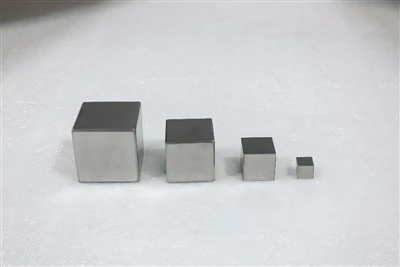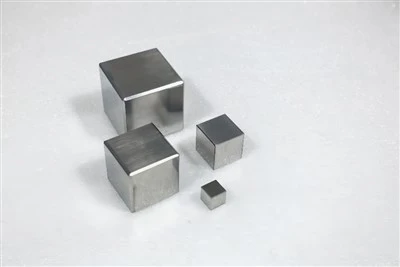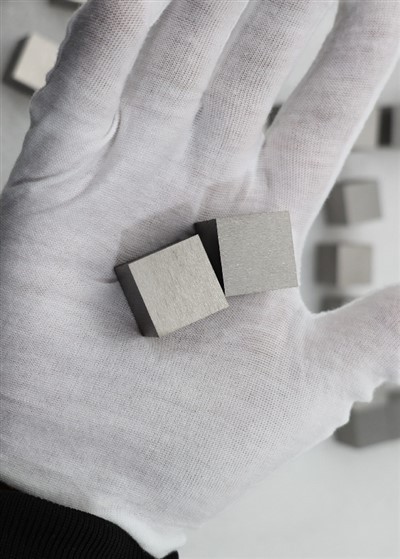

Teaching Use Niobium Blocks (Nb Cubes / Nb Metal Blocks)

The main purchasing groups are middle school / university laboratories, science popularization institutions, element collection teaching aids merchants, etc. For this group, the priority consideration is the display effect, safety, and the accuracy of product identification of the Nb blocks.
comparison of product parameters
| Products name | Niobium cubes |
| Product Material | Pure Nb1 ,Nb 99.95% |
| Purity | Regular 99.95% (3N5), avoiding low-purity recycled materials |
| Standard | ASTM B393 |
| Size | 10mm / 15mm / 20mm / 25.4mm (1-inch cube), the cube is most suitable for teaching comparison |
| Dimension tolerance | ±0.05mm, regular and square, convenient for students to measure volume and calculate density experiments |
| Surface processing | Mirror polishing has strong metal luster and excellent visual effect; Sandblasting matte finish is not easy to leave fingerprints or scratches, and is durable for long-term display |
| Corners | Considering the safety of product use, the edges of the Nb block can be processed, making chamfers, so slightly rounded Nb blocks are preferred, while sharp right angles have the risk of scratching and cutting |
Attention to other information of niobium cubes

The following are essential contents
• Element symbol: Nb
• Atomic number: 41
• Chinese / English: Niobium
• Density: 8.57 g/cm³
Engraving should be clear, with an appropriate depth, not easily worn, and convenient for direct classroom explanation of parameters.
Usually, laser engraving is common and has a higher cost performance, and is widely used.
Safety and packaging
1. The product surface should be free of burrs and sharp flying edges to avoid scratches in the experimental classroom;
2. Independent vacuum-sealed packaging: slows down the slow oxidation on the surface, and is not prone to darkening and discoloration over a long period of storage;
3. Optional acrylic display base, for easy display.


Surface oxidation characteristics
Some courses will demonstrate anodic oxidation color change experiments, but as a supplier of raw materials, usually, we will not provide Nb-based materials that can be anodized;
The original color of Nb will only slowly form a light oxide film in the air, stable at room temperature, non-corrosive, suitable for safe classroom use.
Some courses will demonstrate anodic oxidation color change experiments, but as a supplier of raw materials, usually, we will not provide Nb-based materials that can be anodized;
The original color of Nb will only slowly form a light oxide film in the air, stable at room temperature, non-corrosive, suitable for safe classroom use.
Misconceptions
Teaching use does not require 4N high purity (99.99%), 3N5 (99.95%) is sufficient in terms of cost performance; Ultra-high purity only significantly increases procurement costs, but there is no difference in appearance from a naked eye observation.

By using Nb blocks, more core knowledge about Nb can be understood
Basic element information
1.Element name: Niobium (Nb), symbol Nb, atomic number 41, located in the fifth period of the periodic table in the VB group;
2. Basic physical parameters: Density 8.57 g/cm³, students can calculate density by "weighing + measuring the edge length" themselves;
3.Appearance: Silver-gray rare and refractory metal; stable in chemical properties at room temperature, not prone to rusting
Material Characteristics
1. High Melting Point: 2468℃, a refractory metal.Compared to iron and aluminum, it demonstrates the properties of high-temperature resistant materials;
2. Excellent Corrosion Resistance: Resistant to most acids and bases at room temperature. Compared to iron, it is prone to rusting, and aluminum is prone to oxidation;
3.Non-magnetic: Can be demonstrated with a magnet. The magnet cannot attract niobium;
4. Good Ductility, Not Brittle (compared to tungsten and molybdenum, tungsten has high brittleness at room temperature).
Key Features and Special Knowledge
1. Low Temperature Superconductivity: Critical superconducting temperature of 9.2K.
It is the most commonly used superconducting material in industry (core raw material for nuclear magnetic resonance MRI superconducting coils);
2. Anode Oxidation Coloring Effect: When niobium is electrified and oxidized, it can form different thickness oxide films, generating blue, purple, gold, and rainbow interference colors (the principle of colored metals in many ornaments and element specimens);
3. Niobium-Tantalum Coexistence: Niobium minerals in nature are often associated with tantalum.
The physical and chemical properties of both are extremely similar, and the separation is very difficult;
Real Industrial Applications
Real Industrial Applications (Helping Students Build Understanding)
• Medicine: Good biocompatibility, used for bone implant scaffolds;
• Superconductivity: Medical nuclear magnetic equipment superconducting coils;
• Chemical Industry: Anti-corrosion equipment;
• Alloy: Enhances the strength of steel;
• Cultural Creativity: Element specimens, metal ornaments.
Warning: The density is an intuitive means of differentiation of pure niobium or not: Nb density is 8.57 g/cm³
If you need to know more about niobium or require niobium blocks, please contact us. Our contact information is as follows:
Contact person : Tracy
Our address
Baoji city, shaanxi province , China
Phone Number
0086-18291730106

Hot Tags: teaching block of niobium, China teaching block of niobium manufacturers, suppliers, factory